
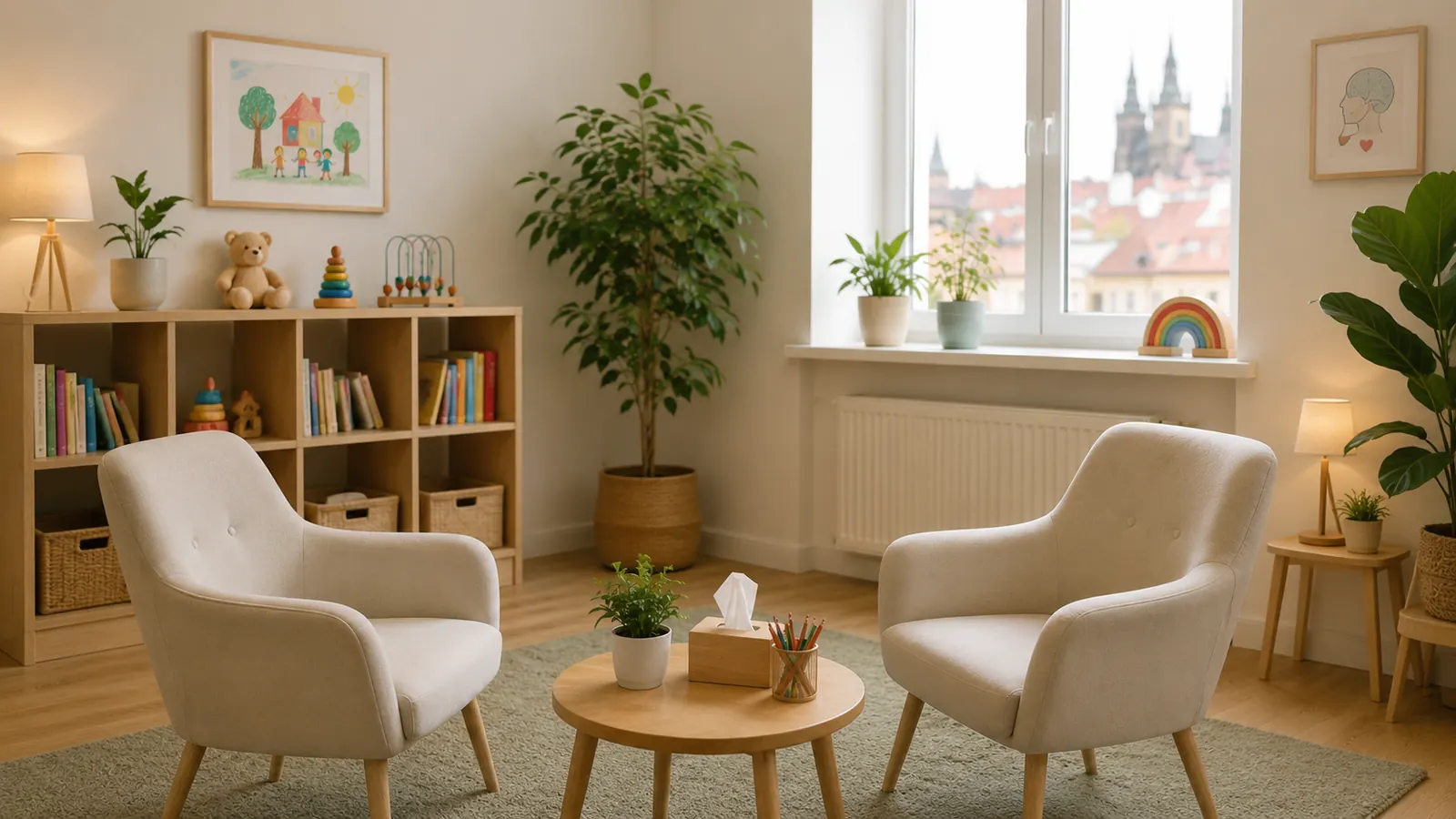
Private practice · Prague 4 – Pankrác
A child’s mind needs time.
Psychiatric care for children and adolescents aged 2.5 to 18, also in English. The initial assessment takes 75 minutes, because a child’s condition cannot be properly assessed in less.
How I can help
Symptoms that bring parents and children to me
You don’t need to know what it’s called. Just tell me what you see at home.
Anxiety and fear
Your child is afraid to go to school, to sleep alone or to speak in front of others. They won’t leave your side, have panic attacks or avoid everyday situations.
Sadness and loss of interest
Things they used to enjoy no longer interest them. They are tired, withdrawn and talk about hopelessness. Or their moods swing between extremes.
Restlessness and poor concentration
They can’t stick with anything and struggle at school despite having the ability. Impulsivity, ADHD and ADD, tic disorders.
Atypical development
Autism spectrum disorders, developmental delay, difficulties communicating and forming relationships with peers.
Eating and body image
Anorexia nervosa, bulimia, overeating linked to psychological difficulties.
Intrusive thoughts and rituals
Obsessive-compulsive disorder: repeated checking, hand washing, thoughts the child cannot get rid of.
Self-harm and crisis
Cutting, other forms of self-injury, suicidal thoughts. Come as soon as possible, don’t wait until things get worse.
After trauma
The aftermath of an accident, violence or the loss of a loved one. Post-traumatic stress disorder.
Serious mental illness
Early-onset and very early-onset schizophrenia, conduct disorders and other conditions requiring psychiatric care.

About the doctor
MUDr. Lenka Ležáková
Board-certified child psychiatrist with many years of experience in outpatient and inpatient care.
My approach to children is empathetic and kind, aiming to understand how they experience things. Parents are not mere observers during the assessment: without you, a child’s condition cannot be assessed, and decisions about treatment remain yours.
I work with the full spectrum of psychiatric conditions in children and adolescents, from anxiety and mood disorders to neurodevelopmental disorders and serious mental illness with early onset.
To save you a wasted trip
What the practice does not provide
I do not provide these services.
- Substance addictions: nicotine, alcohol, drugs
- Behavioural addictions: gambling, addiction to computer games, social media and the like
- Child sexology
- Psychotherapy for children
- Family therapy
- Psychological counselling for parents
- Psychological assessment
- Education for parents of autistic children
The practice is also not an emergency service and does not provide acute or crisis care.
I do not take on patients who already have a psychiatrist and are looking for a second opinion for long-term care. A one-off assessment with recommendations can exceptionally be arranged.
Initial assessment · 75 minutes in total
What to expect at the first visit
So that you and your child know in advance what will happen.
Talking with you
You tell me what is happening at home and what brought you here. Younger children usually stay in the room with you; if your child is happy to play alone in the playroom, we talk without them. One parent, both parents, a foster parent or another legal guardian may attend.
Time alone with your child
With young children I work through play, with older children and teenagers through conversation. Without parents, because children, and teenagers especially, speak differently when no family member is present.
Findings and plan
You come back into the room and I explain what I have found: the diagnosis, the proposed treatment, any medication and what it is for. You can ask anything you need. You leave with a follow-up appointment, usually in a month.
What to bring
Reports from a pedagogical-psychological counselling centre (PPP), a special education centre (SPC) or a clinical psychologist. Reports on any serious illness from your GP or neurologist. Recent blood test results are also helpful.
No referral needed
You can book directly, without a referral from a paediatrician or psychologist. The initial assessment takes 75 minutes, a follow-up 30 minutes and a phone consultation 15–20 minutes.
Fees
What care costs
The practice has no contracts with health insurance companies. You pay for care directly, which means every appointment has enough time, waiting times are short and your sensitive data is not reported anywhere.
| Examinations and consultations | Weekdays | Weekend |
|---|---|---|
| Initial assessmentcomprehensive child psychiatric assessment, 75 minutes | 12,200 CZK | 13,500 CZK |
| Follow-up appointment30 minutes | 6,100 CZK | 8,000 CZK |
| Phone consultationwith child and parent, 15–20 minutes | 3,050 CZK | 4,200 CZK |
Examinations in English
- Initial assessment +1,000 CZK
- Follow-up appointment +500 CZK
- Phone consultation +300 CZK
Weekend appointments can be arranged at the parents’ request.
| Other services | Price |
|---|---|
| Pharmacogenetic saliva teston request; shows how your child metabolises medication | 11,000 CZK |
| Speech and language assessment60 minutes, diagnostic | 4,000 CZK |
| New e-prescription if expiredat a parent’s request | 500 CZK |
| Parent consultations, reports and assessmentspart of the examination | included |
How to pay
Initial assessments and follow-up appointments are paid in advance by bank transfer, no later than two weeks before the appointment. Phone consultations are also paid in advance to the account, as agreed when booking. Please include your child’s first and last name in the payment reference.
Account number: 3177723005/5500
IBAN: CZ82 5500 0000 0031 7772 3005
Cancelling an appointment
If you cancel at least 48 hours in advance, we will refund the full amount paid. For later cancellations, 30% of the amount paid may be deducted, as the appointment usually cannot be offered to another child. Full terms
FAQ
What parents ask most often
Most questions are about medication. Here are the answers I give in my practice.
Are psychiatric medications safe for children? Will they change my child’s personality?
Medication does not change a child’s personality, nor does it impair their intellect. Most medications that were once used only in adults are now routinely prescribed in child psychiatry.
For some of them, the package leaflet advises against use in children, because it does not reflect newer clinical practice and experience. I will always explain why I am proposing a particular medication and what to expect from it.
Can my child become addicted to medication?
No. Medications with addictive potential must not be prescribed to children.
In exceptional situations, such as a severe stress crisis, they may be used for a short time, usually one month. Always after a thorough explanation to the parents and with regular check-ups at the practice.
How long will my child need to take medication?
It depends on the diagnosis and its severity. Some difficulties appear as early as around the age of two and last until pre-puberty; during this period a child needs maximum support so that they don’t drop out of their peer group or start failing at school.
Other conditions begin in puberty and early adolescence and peak in adulthood. Their course is then usually chronic and treatment lifelong.
What if the medication doesn’t work?
This possibility exists and it is good to be prepared for it. In depressive and anxiety disorders, roughly 30–40% of children and adolescents do not respond to the first or second antidepressant. Similar figures apply to severe psychotic conditions, hyperkinetic disorder and ADHD.
At your request, a pharmacogenetic saliva test can be carried out. It shows which medications your child metabolises quickly or not at all, and which could put a strain on the liver.
If medication is not working, I refer the child to a day-care programme where their difficulties are addressed through long-term psychotherapy. I also write a report for the family to support their application for a care allowance.
Does every child with a psychiatric diagnosis need medication?
No. For example, a child with an autism spectrum disorder who is calm and does not harm themselves or others does not need medication. They do, however, need long-term therapies focused on communication, social skills and self-care.
In that case, one visit a year to review their progress is enough, and any time in between if something changes.
What are psychological and speech and language assessments for?
A psychological assessment objectively evaluates a child’s mental state, personality, intellect and cognitive functions. In some cases, the right diagnosis and treatment cannot be determined without it.
A speech and language assessment shows whether a speech or language disorder lies behind the psychiatric difficulties. Such a disorder can lead to anxiety or depression as a secondary effect.
Booking
How to book
By phone until the end of 2026
You can call between 10:00 and 15:00, on the marked days only.
You can call on 11, 12, 13, 16, 18, 19, 23, 25, 26, 27, 30 November and 2, 3, 7, 8, 9, 10, 11, 14, 15, 16, 17, 18, 21, 22, 23, 28, 29, 30, 31 December 2026.
November 2026
December 2026
Day you can call
By email
From 1 January 2027, appointments can be booked by email only.
Write an emailPlease don’t include medical details about your child in your email. Name, age and contact details are enough; we will discuss the rest in person.
Before the initial assessment, I will email you an informed consent form. Please bring it with you signed, or sign it at the practice. By signing it, you agree to how the practice operates and to its fees.
Opening hours
When I see patients
| Monday | 8:45–12:3013:30–18:30 |
|---|---|
| Tuesday | 8:45–12:3013:30–18:30 |
| Wednesday | 9:30–12:0012:30–17:30 |
| Thursday | 8:45–12:3013:30–18:30 |
| Friday | 8:45–12:3013:30–18:30 |
| Saturday, Sunday | by arrangement |
Weekend appointments can be arranged at the parents’ request.
Opening hours may vary depending on the number of booked patients. Patients come at a pre-arranged time.
Where to find me
Address
Na Pankráci 1683/127, 140 00 Prague 4
Gemini A building, by Pankrác metro station (line C)
Getting to the practice
- As you come out of the metro, the Gemini A building is on your right. Reach it via the pedestrian crossing and the tram stop.
- On the ground floor, face the main reception and follow the curve to the right.
- Walk through the winter garden into the second building.
- On your right is the entrance to the Bulovka clinics (ordinace Bulovka). Ring the bell and the receptionist will let you in.
Na Pankráci 1683/127
Gemini A building, 140 00 Prague 4